Abstract
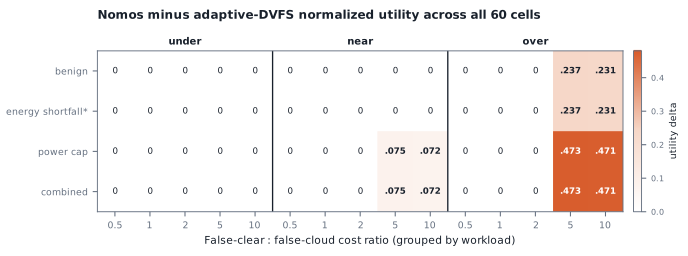
Hardware clock scaling can reduce instantaneous power during onboard inference, but it cannot change a model's error profile or service demand. We screen three CloudScout width tiers at four frequencies on a Jetson Orin Nano, then compare static, scheduled, application-aware DVFS, and joint model/DVFS policies over a frozen 60-cell matrix. A first controller scored well but chattered 24 times, so the matrix stopped. A separately frozen queue-stable revision reduced the same smoke to two transitions. Joint selection adds utility in 12 cells and ties in 48. Every gain requires high false-clear cost and near-saturation or overload. This is a sensitivity boundary and failure study, not statistical, spacecraft, or flight evidence.
Evidence ledger
Three dense CloudScout tiers at 306, 408, 510, and 612 MHz. Full is dominated. Medium and tiny remain non-dominated. The highest tested clock minimizes whole-board joules per tile for every tier.
V1 completes all 320 smoke tasks but switches model 24 times during a 128-task disturbance. The full matrix is intentionally stopped and the failed controller remains immutable.
V2 admits only service-stable actions when one exists, demotes immediately, and requires eight stable observations plus deadline slack before promotion. The smoke falls to two transitions.
Four traces × three workloads × five cost ratios × four policies. That is 240 policy runs, 76,800 task events, and 67,736 real adapted TensorRT engine calls.
Zero TensorRT decision mismatches against sealed references, zero profile-based safety violations, and no answer key on the Jetson during hardware execution.
What this does not prove
The resource traces and one-node thermal plant are synthetic. No operator bus trace, attitude history, calibrated thermal model, or FDIR interaction is present.
Every engine executes at 612 MHz. Lower-frequency actions replay a frozen one-repetition Orin profile table while still invoking the selected real engine.
All 60 scenario cells reuse the same 320-tile shard. The 12/48/0 count maps a deterministic boundary and carries no confidence interval.
The frozen controller result now has a separate physical ground-validation companion.
Two EuroSAT model tiers were trained and measured on the Orin, exposing a real accuracy-energy frontier and a stock-governor cadence effect. Version 1.0 of this paper and its checksum remain unchanged.
Paper and artifacts
Cite
@techreport{nomos2026beyonddvfs,
  author      = {{Nomos Research}},
  title       = {Beyond DVFS: Queue-Stable Model-Tier Selection for
                 Resource-Constrained Onboard Inference},
  institution = {Nomos Research},
  number      = {Nomos-TR-2026-01},
  year        = {2026},
  url         = {https://nomos.run/research/beyond-dvfs/}
}