Abstract
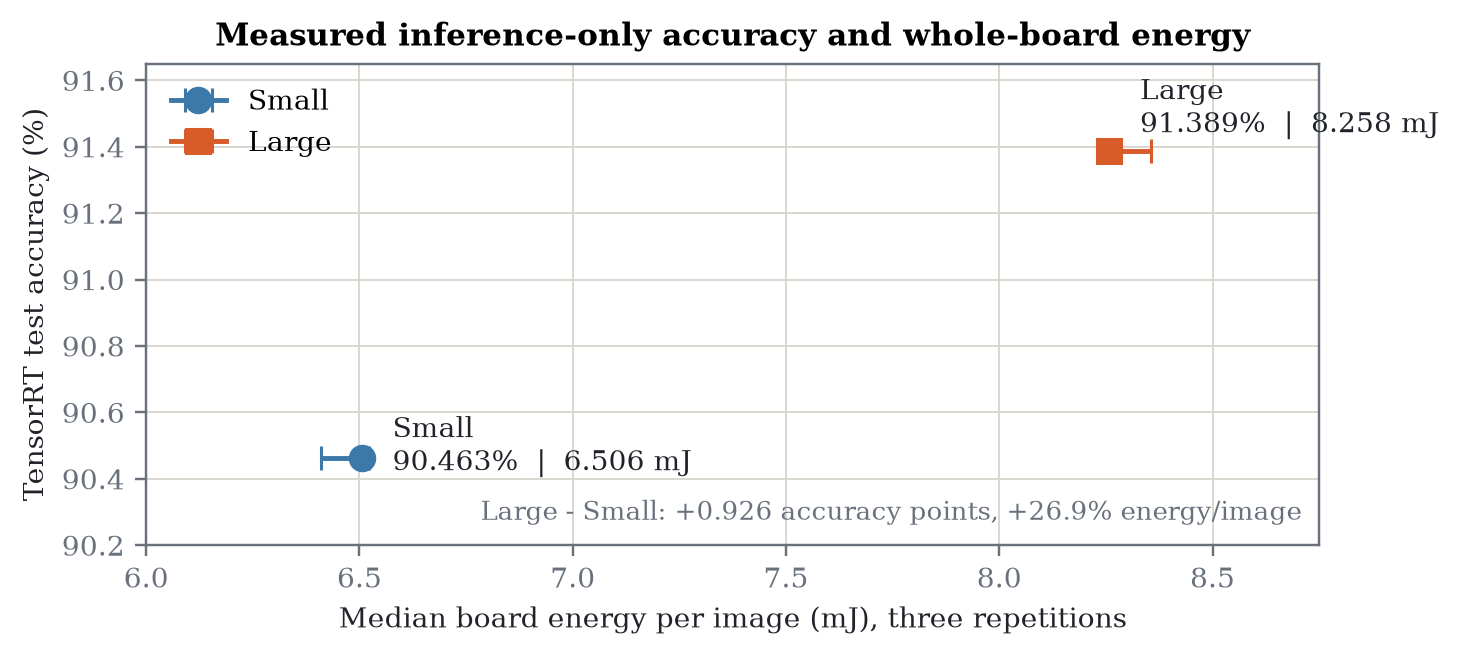
Two MobileNetV3 tiers were fine-tuned directly on an 8 GB Jetson Orin Nano using a fixed spatial split of real Sentinel-2 imagery. Target-built TensorRT engines then processed the same 5,400 held-out images in twelve complete runs. Small reached 90.463% accuracy at 6.506 mJ/image; large reached 91.389% at 8.258 mJ/image. Both are non-dominated. A separate cadence sweep showed why the profile is not just a model property: continuous inference held the GPU near 612 MHz, while modest gaps left it near 306 MHz and nearly doubled latency. This is physical ground evidence, not physical-DVFS, cross-sensor, spacecraft, or flight evidence.
Evidence ledger
MobileNetV3 Small trained in 118.22 seconds and Large in 193.72 seconds. One deterministic eight-epoch run was retained per tier.
Small reached 90.463% at 6.506 mJ/image. Large reached 91.389% at 8.258 mJ/image. Neither dominates the other.
Full-pipeline gaps held EuroSAT inference at 306 MHz; continuous calls promoted the stock governor mostly to 612 MHz. A separate nine-cadence pilot reproduces the effect with a fixed engine.
One large full-pipeline repetition slowed across decode, preprocessing, and inference. It remains in the manifest and every aggregate.
A later fail-closed loader accepted the approved engine and rejected a same-size, one-bit-corrupted copy before TensorRT deserialization.
What this does not prove
The stock governor was observed, not controlled. No policy changed clocks per task, and no transition overhead was measured.
The split changes geography within Sentinel-2 RGB. It does not train on one instrument and test on another.
Board telemetry is uncalibrated VDD_IN. There is no spacecraft thermal plant, radiation environment, operator trace, or flight-software integration.
Beyond DVFS remains frozen at version 1.0.
This companion note adds separate physical ground evidence. It does not alter the earlier controller matrix, its 12-win and 48-tie boundary, or its checksum.
Paper and artifacts
Related systems work
Cite
@techreport{nomos2026oringroundvalidation,
  author      = {{Nomos Research}},
  title       = {Ground Validation of Model-Tier Inference for
                 Earth Observation on a Jetson Orin Nano},
  institution = {Nomos Research},
  number      = {Nomos-TR-2026-02},
  year        = {2026},
  url         = {https://nomos.run/research/orin-ground-validation/}
}